
BJJ Belt System Explained: Complete Guide to Ranks and Progression
By Gracie Barra Celebration · April 2026
The belt system in Brazilian Jiu-Jitsu is one of the most respected ranking systems in martial arts. Unlike disciplines where belts can be earned in months, BJJ belts take years of dedicated training — making each promotion a genuine milestone. A BJJ black belt represents roughly 10-15 years of consistent practice, which is why the belt carries so much weight in the martial arts world.
Whether you're considering starting BJJ, you're a white belt wondering what's ahead, or you're a parent trying to understand your child's progress, this guide covers everything you need to know about how the belt system works.
Adult Belt System
The adult BJJ belt system (ages 16+) consists of five main belts, each with up to four stripes that mark progress within that belt level.
White Belt
Every adult's BJJ journey begins at white belt. There are no prerequisites — you walk in the door, you're a white belt. This phase focuses on survival, basic positions, fundamental escapes, and building a movement vocabulary. Most students spend 1-2 years at white belt before their first promotion.
What you should focus on: learning the positions (mount, side control, guard, back control), basic escapes from each position, two to three submissions, and developing mat awareness. At Gracie Barra Celebration, Professor Rodrigo's fundamentals curriculum is specifically designed to build these foundations systematically.
Blue Belt
Blue belt is the first real milestone — and statistically, it's where the biggest dropout happens. The initial excitement of learning something new fades, and students must transition from novelty-driven motivation to discipline-driven training. A blue belt has a solid understanding of fundamental positions, can defend themselves effectively against untrained opponents, and is starting to develop their own "game" — preferred techniques and strategies that suit their body type.
Average time at blue belt: 2-3 years. Total training time to reach blue belt: 1-2 years.
Purple Belt
Purple belt is where practitioners start becoming dangerous. A purple belt has a deep understanding of the game, can flow between positions, and has developed sophisticated attacks and defenses. Many purple belts begin assisting with teaching, as they have enough knowledge to help lower-ranked students effectively. In the broader martial arts world, a BJJ purple belt is considered equivalent to a black belt in many other disciplines in terms of overall fighting competence.
Average time at purple belt: 2-3 years. Total training time to reach purple belt: 4-5 years.
Brown Belt
Brown belt is the refining phase. The major techniques are already learned — now it's about sharpening details, closing gaps in your game, and developing a higher level of strategic thinking. Brown belts are often described as "almost black belts" because the technical gap between brown and black is smaller than at any other transition. Many brown belts teach regularly and are considered expert-level practitioners.
Average time at brown belt: 1-2 years. Total training time to reach brown belt: 6-8 years.
Black Belt
A BJJ black belt represents mastery of the art's fundamental techniques and the ability to apply them against resisting opponents of any size or skill level. But unlike many martial arts where the black belt is the end, in BJJ it's often described as the beginning of truly deep learning. Black belt is when practitioners begin developing their own unique contributions to the art.
Total training time to reach black belt: 8-15 years. This is not a typo. A decade of consistent training is the norm, not the exception.
Beyond black belt, the system continues with degrees (up to 6th degree), coral belts (7th and 8th degree, a combination of red and black or red and white), and the red belt (9th and 10th degree), which is reserved for grandmasters who have spent a lifetime advancing the art.
The Stripe System
Within each belt, students can earn up to four stripes — small pieces of tape wrapped around the belt. Stripes serve as intermediate markers of progress, letting students know they're advancing toward their next belt promotion. At Gracie Barra, stripe promotions are based on:
- Attendance and consistency: Showing up regularly is the foundation of progress
- Technical knowledge: Demonstrating the techniques covered in the curriculum
- Live performance: Applying techniques effectively during sparring
- Character and attitude: Being a good training partner, showing respect, contributing to the academy community
Not all instructors use stripes the same way, but at GB Celebration, Professor Rodrigo uses them as meaningful markers — each stripe represents genuine progress, not just time served.
Kids Belt System
Children under 16 have a different belt system with more colors, providing frequent promotion opportunities that keep young students motivated. The kids belt system at Gracie Barra includes:
White Belt
Every child's starting point. Focuses on basic movements, coordination, and mat etiquette.
Grey Belt (3 variations)
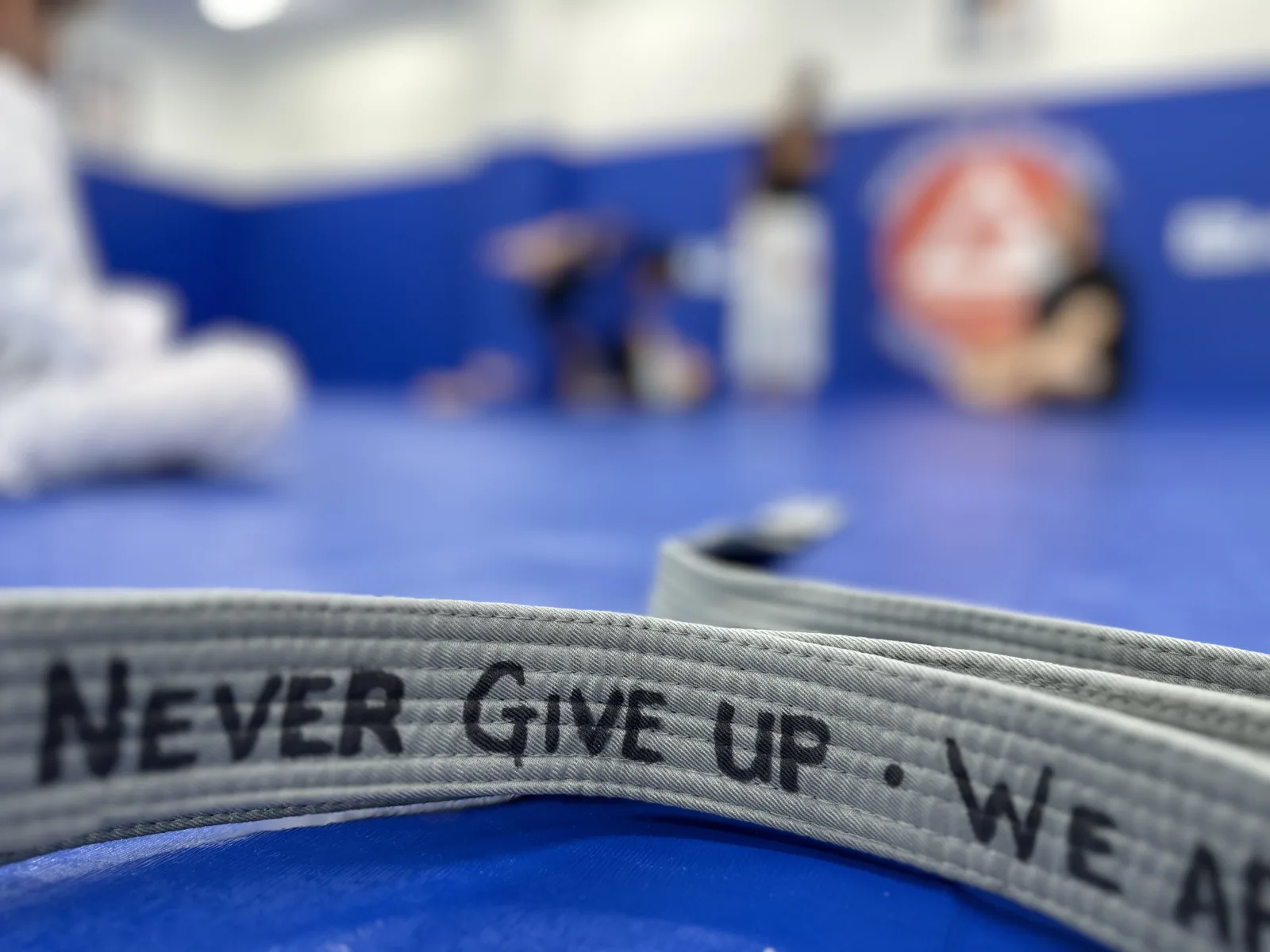
Grey belt comes in three versions: grey/white, solid grey, and grey/black. These are typically the first promotions for younger children and mark the transition from complete beginner to foundational understanding.
Yellow Belt (3 variations)
Yellow/white, solid yellow, and yellow/black. By yellow belt, kids have a solid grasp of basic positions, can defend themselves against untrained peers, and understand the concepts of sweeps and submissions.
Orange Belt (3 variations)
Orange/white, solid orange, and orange/black. Orange belt kids are becoming genuinely skilled — they have preferred techniques, can compete effectively in tournaments, and often serve as role models for newer students.
Green Belt (3 variations)
Green/white, solid green, and green/black. The highest kids belt level. Green belt children have years of training and significant technical ability. When they turn 16, they're eligible for promotion to the adult belt system — typically blue belt, though exceptionally skilled teens may receive blue belt even earlier.
Each kids belt also uses the four-stripe system, giving children frequent acknowledgment of their progress. For young students at GB Celebration, stripe ceremonies are exciting events that reinforce the connection between consistent effort and achievement.
How Promotions Work at Gracie Barra
Gracie Barra follows IBJJF (International Brazilian Jiu-Jitsu Federation) guidelines for minimum time at each belt, ensuring that promotions are earned through genuine development. At GB Celebration, promotions are determined by Professor Rodrigo based on:
- Curriculum completion: Demonstrating proficiency in the techniques required for each level
- Consistent training: Regular attendance over an extended period
- Sparring performance: Applying techniques effectively against resisting partners
- Character: Embodying the Gracie Barra values of brotherhood, integrity, and development
- IBJJF minimums: Meeting the minimum time-at-belt requirements set by the federation
Belt promotions at GB Celebration typically happen during special ceremonies where the entire academy gathers to celebrate each student's achievement. These events are a highlight of our community and reinforce the significance of each promotion.
Why the BJJ Belt System Is Different
In many martial arts, a black belt can be earned in 2-4 years. In BJJ, that timeline is 10+ years. This isn't arbitrary — it reflects the depth of the art and the requirement to demonstrate skill against fully resisting opponents. There's no such thing as a "paper belt" in BJJ — every rank must be proven on the mat.
This rigorous standard is what gives the BJJ belt system its credibility. When you see someone wearing a BJJ purple belt, you know they've invested 4-5 years of consistent training. When you meet a black belt, you're talking to someone with a decade or more of mat time. That authenticity is rare in the martial arts world, and it's something we take pride in at Gracie Barra.
Start Your Belt Journey
Every black belt started as a white belt who simply refused to quit. If you're ready to start your journey through the BJJ belt system, Gracie Barra Celebration offers a school tour for students of all ages. Our structured curriculum, led by Professor Rodrigo and supported by Coach Ryan and Coach Marcello, is designed to guide you from your first day to your first stripe — and every promotion beyond.
Visit us at 1420 Celebration Blvd, Suite 108, Celebration, FL 34747 or call (407) 739-4666 to schedule your school tour.