
BJJ vs Wrestling: Which Grappling Style Is Better?
By Gracie Barra Celebration · August 2026
Brazilian Jiu-Jitsu and wrestling are two of the most effective grappling martial arts on the planet. Both will make you a formidable grappler, but they approach the problem of controlling another human being from fundamentally different angles. If you're trying to decide which one to train — or wondering how they compare — this breakdown covers the key differences in technique, rules, self-defense application, and training culture.
The Core Philosophy: Top vs Bottom
The simplest way to understand the BJJ vs wrestling divide is this: wrestling is about getting on top and staying on top. BJJ is about being dangerous from everywhere — including your back.
Wrestlers train relentlessly to take opponents down and pin them. The entire sport rewards controlling position from above. A wrestler's worst nightmare is being put on their back, because in wrestling, that's how you lose.
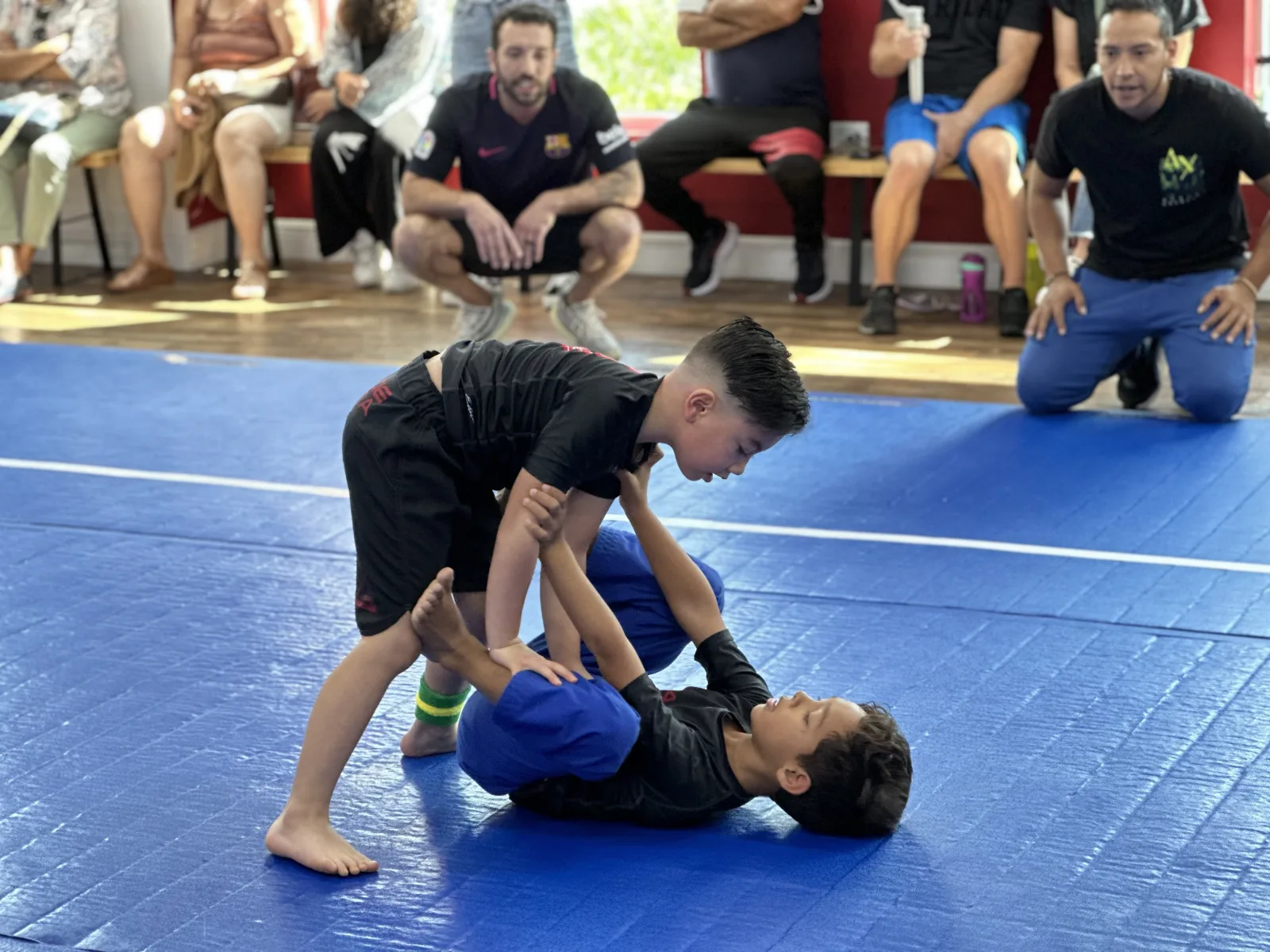
BJJ flips this logic. While being on top is still advantageous, a skilled BJJ practitioner can attack with submissions from bottom positions like guard, half guard, and even while being mounted. The guard — where you control an opponent between your legs while on your back — is one of BJJ's most revolutionary contributions to martial arts. There is no equivalent in wrestling.
Takedowns vs Guard Play
Wrestling produces the best takedown artists in combat sports. Period. Techniques like the double leg, single leg, high crotch, and various throws are drilled thousands of times until they become reflexive. Wrestlers enter grappling exchanges with an explosive, aggressive pace that's difficult to match.
BJJ practitioners, by contrast, often start training from the knees or in seated guard positions. While BJJ does include takedowns — and many advanced practitioners develop strong takedown games — the art places far more emphasis on what happens after the fight hits the ground. Sweeps, transitions, positional control, and submissions are the bread and butter of BJJ training.
This difference matters in a real scenario. A wrestler can put almost anyone on the ground. A BJJ practitioner can finish the fight once it gets there. The combination of both is why you see so many successful MMA fighters cross-training in both disciplines.
Competition Rules: Pin vs Submit
In wrestling, you win by pinning your opponent's shoulders to the mat, accumulating points through takedowns and exposure, or building a large enough point lead for a technical fall. Matches are fast — typically two or three periods of two to three minutes each. There are no submissions allowed.
In BJJ competition, you win by submitting your opponent (forcing them to tap out via joint lock or choke) or by accumulating points through sweeps, takedowns, guard passes, and achieving dominant positions like mount or back control. Matches are longer — typically five to ten minutes depending on belt level — and the pace tends to be more strategic.
The IBJJF Pan Championship, one of the largest BJJ tournaments in the world, is held annually right here in Kissimmee, FL. Our students at Gracie Barra Celebration regularly train for and compete in IBJJF events, guided by Professor Rodrigo Frezza and our coaching team.
Self-Defense: Which Works Better on the Street?
Both arts are highly effective for self-defense, but they solve different problems.
Wrestling gives you the ability to dictate where the fight takes place. If someone attacks you, a wrestler can take them down at will or stay standing if that's the better option. The ability to control distance and positioning is a massive advantage in any confrontation.
BJJ gives you the tools to end a fight without throwing a punch. Joint locks and chokes allow a smaller person to neutralize a larger, stronger attacker — which is the core principle Helio Gracie built the art around. If a confrontation goes to the ground (and data from law enforcement studies suggests most violent encounters do), BJJ provides a complete system for controlling and finishing the situation.
For pure self-defense, BJJ has an edge because of submissions. Wrestling can control an opponent, but it doesn't offer the same ability to end the fight decisively. A wrestler who pins someone on the street still has to figure out what to do next. A BJJ practitioner can apply a choke to safely neutralize the threat.
Physical Demands and Training Style
Wrestling is one of the most physically demanding sports in existence. Training involves intense conditioning, explosive drills, live wrestling at high intensity, and grueling practices that push cardiovascular and muscular endurance to the limit. Wrestling seasons are short and intense, and the culture emphasizes toughness and mental grit.
BJJ training can be just as physically demanding, but the culture generally allows for more control over intensity. You can train BJJ at 50% effort during a technical roll or go 100% during competition preparation. This scalability makes BJJ more accessible to a wider range of ages and fitness levels. At Gracie Barra Celebration, we have students from age 3 to adults over 50, all training at intensity levels appropriate for their goals.
Can You Train Both?
Absolutely — and you probably should. The best grapplers in the world have skills from both disciplines. Wrestling gives you the takedown ability and top pressure that many pure BJJ players lack. BJJ gives you the submission game and guard work that wrestlers never develop.
Many of our students at Gracie Barra Celebration come from wrestling backgrounds and find that BJJ complements their existing skills perfectly. The transition from wrestling to BJJ is one of the smoothest in martial arts — your athleticism, body awareness, and understanding of leverage translate directly. You'll just need to learn to be comfortable fighting from your back, which takes some mental rewiring for lifelong wrestlers.
We also offer MMA classes for students aged 14 and up, which combines striking with grappling and gives you opportunities to blend wrestling and BJJ in live training scenarios.
Which Should You Choose?
If you're a school-age athlete with access to a wrestling program, do both. Wrestling in school and BJJ at an academy like Gracie Barra will make you a complete grappler faster than focusing on either one alone.
If you're an adult looking to start grappling for the first time, BJJ is typically the more accessible entry point. The training culture is more welcoming to beginners, the risk of injury can be managed through controlled rolling, and you can train well into your 40s, 50s, and beyond. Wrestling programs for adults are rare outside of college towns.
If self-defense is your primary goal, BJJ offers a more complete solution because of the submission system. If athletic competition and explosive grappling are what excite you, wrestling delivers one of the most intense competitive experiences in any sport.
Train Grappling at Gracie Barra Celebration
Whether you're a wrestler looking to add submissions to your game or a complete beginner choosing your first grappling art, Gracie Barra Celebration has programs designed for your goals. Professor Rodrigo Frezza and our coaching staff — including Coach Ryan and Coach Marcello — bring decades of combined experience to every class.
We offer Adults BJJ (Gi and No-Gi), Kids BJJ for ages 3 and up, Muay Thai, MMA, and dedicated self-defense classes. Our academy is located at 1420 Celebration Blvd, Suite 108, Celebration, FL 34747, and we serve families across Celebration, Kissimmee, Four Corners, Champions Gate, and the greater Osceola County area.
Call us at (407) 739-4666 or visit our website to schedule a tour class.